180: Green River

Hidy, friends and neighbors. Good to be partnering up with Claude on another podcasting project! This episode is about a song whose title vaguely sounds like the result of a chemical spill, but which is actually a classic piece of rockabilly.

John Fogerty and his brother Tom were natives of Northern California, and their family vacations often were to a cabin in Yolo County, just west of Sacramento. That cabin was next to both a lake and a creek, and the Fogerty boys would play in and around that creek during vacations. And yes, you’ve guessed it, the water there did have a greenish tint because of algae and other natural phenomena.  Coincidentally, Green River was John’s favorite flavor of soda pop as well (though I’m not sure I would drink anything with that name these days).

Fast forward a few years to the mid 1960s, and John and Tom, along with their buddies Stu Cook and Doug Clifford, are in a local band called the Golliwogs. They picked a new name in January 1968, shortly after they got their record contract, and were thereafter known as Creedence Clearwater Revival. They followed the natural route of local gigs, then national tours, and then record releases. The song titles are familiar: Susie Q, Bad Moon Rising, Born on the Bayou, Proud Mary (which Claude covered on an episode of How Good It Is a while back, and then the song that hearkened back to John’s salad days at that creek in Yolo County.  

Give it a listen to see how Roy Orbison rubbed off on the boys from El Cerrito, and how the song fits into the overall CCR legacy.

Click here for a transcript of this episode. 

Click here to become a Patron of the show.

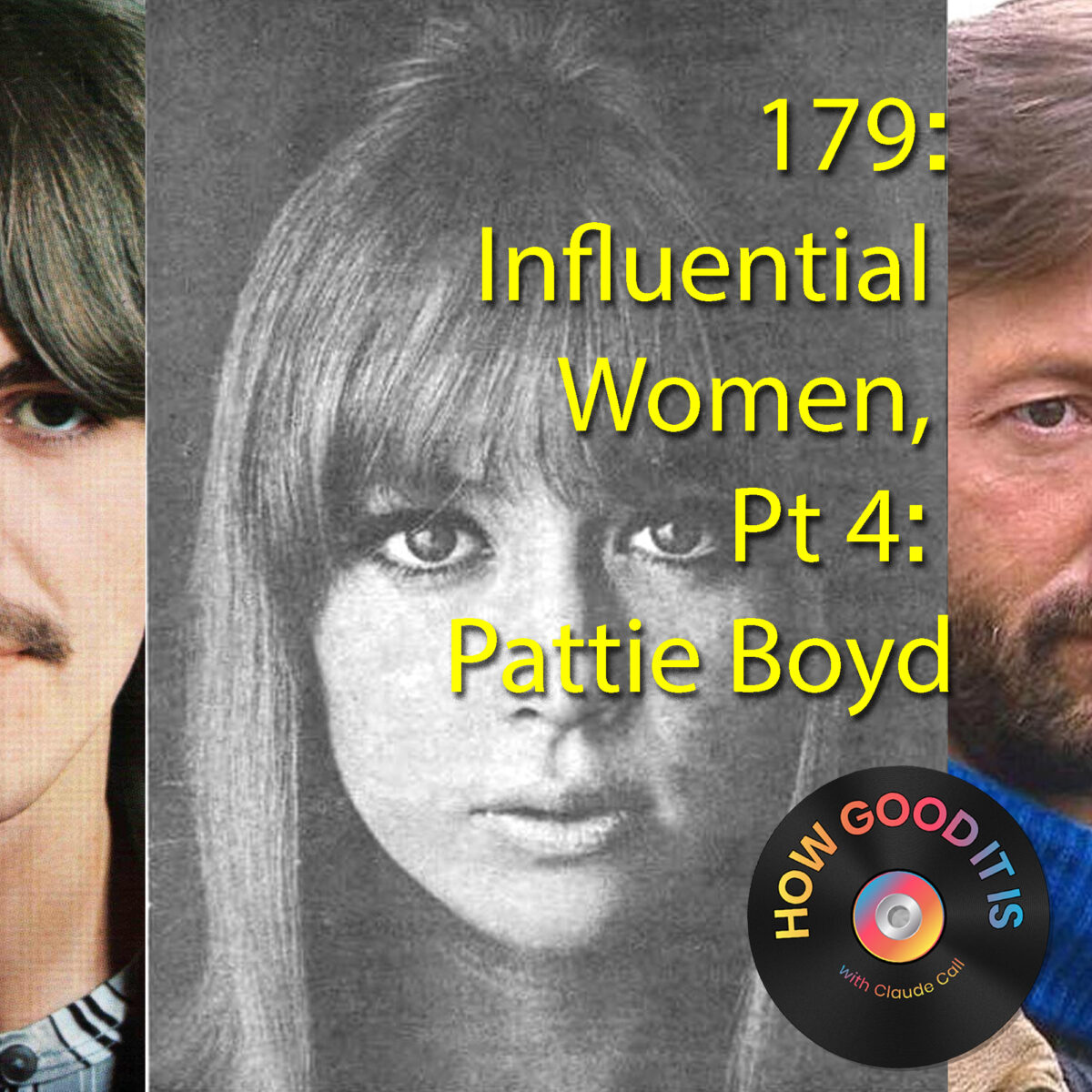
179: Influential Women, Pt. 4–Pattie Boyd

Ladies and Gentlemen, the queen of them all.

Pattie Boyd was the inspiration for a huge number of songs. Some of them went to the top of the charts, some of them weren’t released as singles, but nearly all of the songs about her are well-known, and not just because they’re about her; because they’re actually pretty darn good.

And the crazy part is that all of them came from two men: George Harrison and Eric Clapton. There’s a song in Clapton’s catalog that could have easily been about her if you try to read into the lyrics, but it’s more coincidence than anything else, since it wasn’t written by Clapton. But it’s also quite possible that the lyrical content is one of the things that gave it its appeal to Clapton. Who knows.

When I return to this topic (in two episodes), we’ll talk about the other contender for the big title.

If you’re a Patron of the show, you’ve already gotten this episode in your Patreon feed. Feel free to listen again here, if you’re so inclined. Newsletter should be back next week; I’m still readjusting my work flow. You can click here to become a Patron of the show.

Click here for a transcript of this episode. 

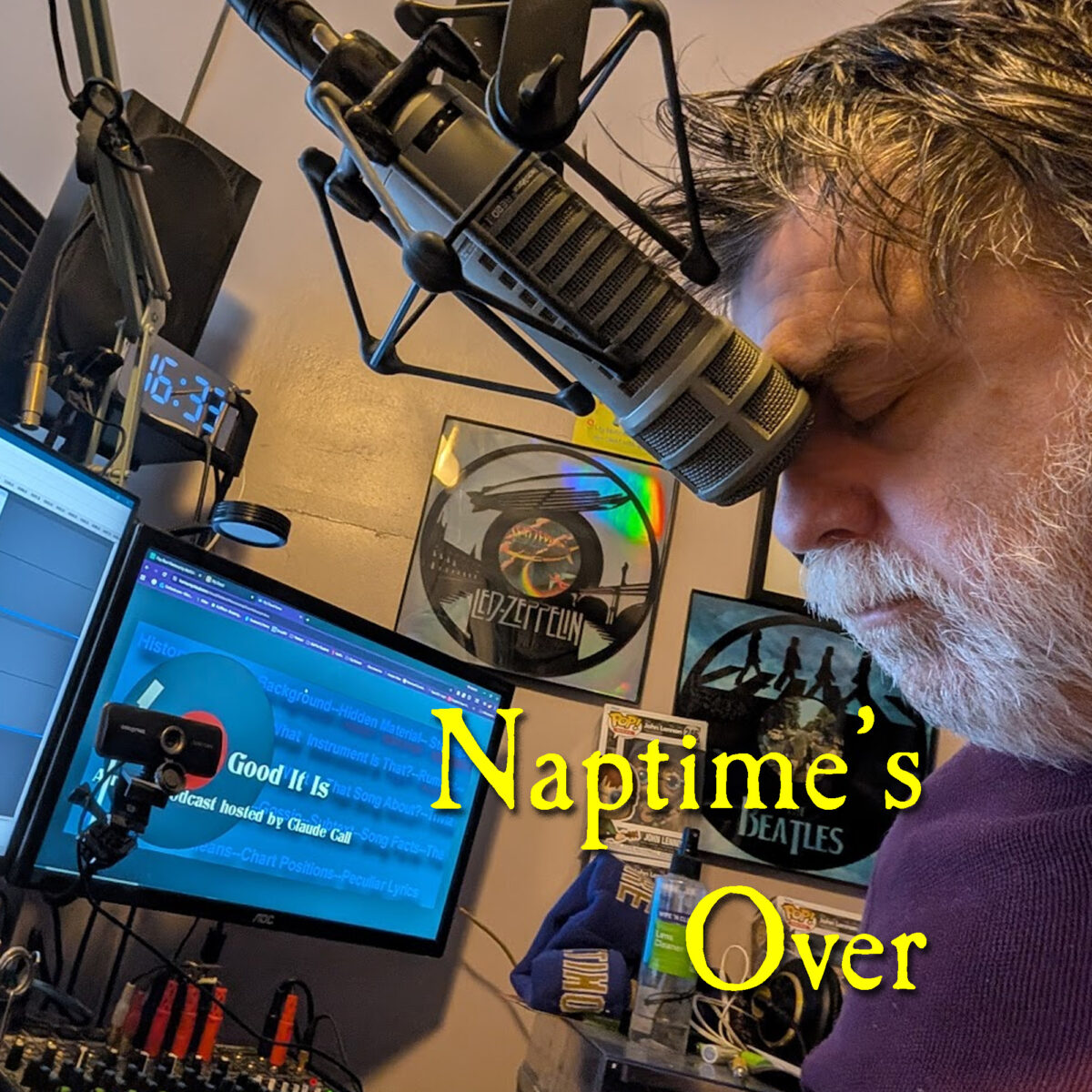
178b–Naptime’s Over

Where have I been?

Life, Cousin. Life got in the way. A lot of things sidetracked me, and even though I was keeping the feed for this show active, I still had several moments of “Yeah! Gonna get back to it soon!” alongside an equal number of “why bother?” moments.

I’ve also been working on a different podcast project with Mike Messner, who you might remember from a couple of Gordon Lightfoot episodes we did here. I talk about it during the episode, but you can check it out here.

Mike convinced me that there was still more to say; in addition he wanted to help me say it. In addition, I wanted to move the show a little closer to its original educational roots. There’s more about that during the episode, too.

So, bigger picture: Mike is going to take on some of the hosting duties, and I’m going to be doing a mix of new shows and a re-work of old shows. We have roughly the next 20 or so episodes mapped out, and while Mike will be writing and producing his own stuff, I’ll be reviewing scripts and dealing with final production, plus I’ll be dealing with the show notes (the stuff you read here) for the time being.

Have a listen, get The Rest Of The StoryTM, and let’s re-light this candle!

178a: Mistakes Were Made

This note is specifically for the few hundred of you who downloaded the episode only a short time after it dropped.

I got a very nice note from Cousin Richard, who pointed out to me that the Marshall Amplifier Company was founded by Jim Marshall, at Bletchley in Milton Keynes. That’d be the same Bletchley which is now famous for being the top-secret home of the World War Two codebreakers. Richard recalls being about ten years old and his father taking him down to the Marshall shop on High Street, and seeing Jim from time to time in the store.

I’d seen the Tom Marshall thing somewhere and, because it didn’t so much add anything to the Jane Asher story as it was a little bit of lagniappe to the trivia question, I didn’t scrutinize it more deeply, which clearly came back to bite me.

If you download the episode anew, you’ll get the same episode with my correction patched in, but if you don’t, it’s no biggie. I do regret the error and I thank Cousin Richard for setting me straight.

178: Influential Women, Part 3–Jane Asher

Of all the people in the Beatles’ inner circle, Jane Asher is perhaps the most mysterious.

Not because she’s reclusive–far from it, in fact. Jane Asher has spent lots of time on stage and on screens large and small from the time she was a  child. But other than newspaper and magazine articles, and maybe a few video clips which survive from the 1960s, there isn’t a lot of first-hand knowledge about her relationship with Paul McCartney.

For about five years she was his girlfriend, and she had a front-row view of the beginnings of Beatlemania, the madness of touring, the changes in the band’s sound, the death of Brian Epstein, the psychedelic period, even the visit to India. But she finds it insulting when people ask her about those days. And even though she’s written several books, both fiction and non-fiction, none of them are about The Beatles. She may be the only person who’s had prolonged contact with the band who hasn’t written a book about it.

But Paul McCartney, tunesmith that he is, wrote several songs about Jane Asher. In later years, he’d mostly concede only that they were songs of a personal nature rather than saying something like “It’s about Jane,” possibly as a means of respecting both her and his late wife Linda, but a pretty straight line can be drawn between some of the events in their respective lives and the subject matter of his songs.

Click here for a transcript of this episode. 

Click here to become a Patron of the show. Paid-level Patrons get a newsletter about 48 times per year (I do take the occasional week off); Free-level Patrons get it two weeks later. So why not join? What’s to lose?

177: Influential Women, Pt.2–Rosanna Arquette

In case you haven’t heard, we’re on a little bit of a journey, meeting various women who have had an influence on multiple pop songs. In today’s episode we’ll be visiting Rosanna Arquette.

The interesting thing here is that whether or not the songs in this episode are about Rosanna has been an on-again, off-again mystery. For a while they’re not, then they are again, and maybe, maybe not. Personally I think the evidence is there, although I can accept the explanation that there are other models for one song and there’s a deliberate ambiguity in the other, because of the nature of the music that was influencing the singer.

At any rate, there’s a terrific storm going on tonight and I’ve already lost power briefly one time; let me get this out before there’s another outage.

Click here for a transcript of this episode. 

Click here to become a Patron of the show. Paid members get a newsletter 48 times per year and ad-free episodes. Free members get the newsletter on a delayed basis.


176: Influential Women, Pt1–Renee Fladen-Kamm

For the next several episodes, we’re going to take a look at the women who inspired some of the Rock Era’s most iconic songs.

There will be six episodes in this series; five of them will concentrate on a specific woman, each of whom inspired multiple songs. The sixth episode will look at several women who each inspired a single song. A couple of the women I’ve chosen will be fairly obvious but I’m hoping a couple will come as a surprise to you.

And this episode, I hope, is one of the surprises. We’ll be taking a look at Renee Fladen-Kamm, who was just Renee Fladen back in the day. This young woman inspired three songs, all with a similar theme to them. Two of the songs became big hits for the artist, and the third…not so much. But there’s a pretty good cover that I mention during the episode.

Click here for a transcript of this episode.

Click here to become a Patron of the show. Patrons receive a weekly newsletter about 48 times a year (I dunno, I don’t count, but I don’t take a lot of weeks off), plus bragging rights and an advance release of the episode, so you get it ad-free. How’s that for a deal!

175: In the Still of the Night

After this many episodes, it gives me a moment of “Huh, isn’t that interesting” when I start writing the post for an episode and discover that I haven’t covered a song from that particular year before. In this case, that year would be 1956.

In retrospect, that shouldn’t be a surprise, given that we’re reaching waaay back into the early days of the Pop music era. But it’s still a fun little statistic, regardless.

“In the Still of the Night” was originally “In the Still of the Nite,” partly because they didn’t want this song to be confused with a 1936 song written by Cole Porter and recorded several times over the years. The other reason is that it was a little bit of a trend to spell “Nite” like that. (See also The Dells’ “Oh What a Nite”.) Later on the spelling changed to the more conventional style, and you’d often see “(I’ll Remember)” tacked on. Why it’s “I’ll remember” and not “I remember”, I have no idea.

This wasn’t relevant to the broader story, but in 1986 Ronnie Milsap recorded a song called “Lost in the Fifties Tonight”, where he recounts some fond memories from listening to this song. As part of the chorus he actually sings a few bars of this song.  That song went to #1 on the Billboard Country Chart and earned Milsap a Grammy for Best Country Male Performance.

And finally, I didn’t promise this during the episode, but here’s the song from the Trivia Question (go listen to the episode first!):

This link doesn’t have any actual video to it, but do a search and you’ll catch a lot of fun videos associated with the song. You won’t even mind hearing it repeatedly because it’s a genuine banger.

Click here for a transcript of this episode.

Click here to become a Patron of the show. Patrons get a newsletter about 48 times a year (I never counted, but I don’t skip weeks often) and now they get advance access to ad-free episodes.

174: Don’t Fear the Reaper

This is an episode I wrote in the Southern Studio, so I may  have been in a better mood than usual to write it than I ordinarily am, given  the subject matter.

When Blue Öyster Cult first got together, they were a college band from Stony Brook, New York. That’s not far from where I grew up. Oddly, none of the band’s original members are from Long Island. Two of them grew up in New  York City, one in upstate NY and the last was born in Alabama but moved to the Island as a child. Go figure.

They took on the name Soft White Underbelly first and used that from 1967-1969. Then they caught a bad review for a show and decided to change their name. After a few permutations they landed on Blue Öyster Cult, which they didn’t really like. But the fact is, they didn’t care enough at that point to come up with anything else.

I touched on this briefly in the episode itself, but it’s pretty clear that the band members were still pretty fond of “Soft White Underbelly”. Oftentimes when they played smaller clubs around the NY Metro area, that’s the name they’d use in those clubs. So when fans of BOC saw an ad in the local newspapers touting that band in the 1970s and 80s, they knew they were actually in for a Blue Öyster Cult show.

“Don’t Fear the Reaper” is notable for several different reasons. It was a new recording studio and they experimented with their sound in different ways. That would include having Buck Dharma sing the lead. (Dharma is the lead singer on “Godzilla” and “Burnin’ For You”, so they may have hit on something there.) You’ll hear about some of the bells and whistles they use.

And yes, you’ll hear a little bit about Saturday Night Live and how they feel about it.

Click here for a transcript of this episode.

Click here to become a Patron of the show. Patrons get a newsletter about 48 times a year (I never counted, but I don’t skip weeks often) and now they get advance access to ad-free episodes.

173: Wichita Lineman

By 1968, Glen Campbell had moved from session musician to a star in his own right. His single “By the Time I Get to Phoenix,” written by Jimmy Webb, was a huge hit for him. So when Campbell decided he needed another song, he turned back to Webb and asked him for another song.

For whatever reason, he asked Webb to make it a song about a specific location. Webb, at that time, was in the business of writing as many songs as possible about his ex, a woman named Susan Horton. (Coincidentally, Jim Holvay was also spending a lot of time writing songs about a woman named Susan, go figure.) Susan Horton was at the heart of “Phoenix” and “MacArthur Park, which had just been released when Campbell came calling again. So he cranked out yet another song ostensibly about Susan. That song was “Wichita Lineman.”

Now, Webb wasn’t as obvious about Susan as Holvay was, but in all of these songs you can hear some sense of loss and longing, so it’s pretty clear that he had it bad for her. And between Webb’s nearly-finished work and the production values that Campbell and producer/arranger Al De Lory, before long they had a genuine masterpiece on their hands. And honest to god, why haven’t I covered this song back when the show was still in single digits?

What else haven’t I covered that really needs some attention? Drop me an email  at howgoodpodcast@gmail.com!

Click here for a transcript of this episode. 

Click here to become a Patron of the show. Patrons get a newsletter about 48 times a year, plus a few other goodies from time to time.